
WEYMOUTH MA MOLD REMOVAL
Mold Removal in Weymouth, MA may be appropriate when professional assessment, testing, or clearly documented visible conditions establish that fungal growth is present on building materials. Effective remediation should address both the affected material and the moisture condition that allowed growth to develop rather than treating mold as an isolated surface problem.
PowerBees approaches Mold Removal conservatively and recommends remediation when documented conditions support it. Weymouth homes and commercial properties can experience moisture from plumbing leaks, roof failures, basement water intrusion, inadequate bathroom ventilation, condensation, and other building-specific sources; the appropriate scope depends on where the moisture occurred and which materials were affected.
Mold Removal Services in Weymouth, MA
Mold Removal is not the correct response to every odor, stain, dusty surface, or elevated-humidity reading. PowerBees believes remediation should be based on documented conditions rather than fear or assumption. In many situations, Mold Testing or a focused inspection can help determine whether remediation is necessary and, just as importantly, how limited or extensive the scope should be.
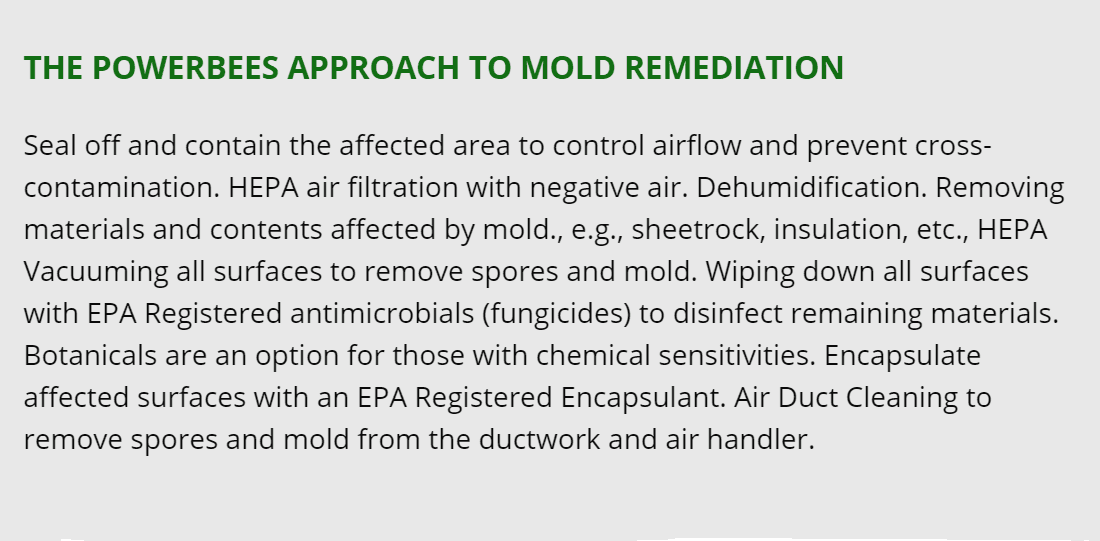
When fungal growth is confirmed, the remediation process should address the affected material while controlling the movement of dust and spores into adjacent areas. Porous materials that are substantially affected may require removal, while some structural materials can be cleaned and treated when conditions permit. The moisture source must also be corrected or managed because removing mold without addressing recurring water or humidity does not resolve the underlying building condition.
Weymouth's mix of older homes, postwar neighborhoods, renovated properties, multifamily housing, and commercial buildings creates many different remediation scenarios. A basement affected by long-term moisture is different from a bathroom with failed ventilation, a ceiling affected by an isolated plumbing leak, or a commercial space following a roof event. The scope should reflect the actual area and material involved.
PowerBees maintains IICRC certification in Applied Microbial Remediation and has nearly two decades of experience with Indoor Air Quality services. The company also performs Mold Testing, allowing environmental conditions to be evaluated before or after remediation when objective sampling is appropriate.
Residential Mold Removal - Weymouth
Residential Mold Removal in Weymouth commonly involves localized moisture events rather than an entire house. Bathrooms, basements, attics, areas around plumbing, and rooms affected by roof or exterior leaks are among the locations where fungal growth may develop when materials remain damp. The first task is to understand why the material became wet and whether that condition is still active.
Bathrooms illustrate the importance of moisture control. An inoperative or poorly performing exhaust fan can allow humidity from showers to remain in the room, particularly on ceilings and upper wall surfaces. Cleaning or removing affected material without restoring adequate ventilation can leave the underlying cause unresolved. PowerBees now provides Bathroom Exhaust Fan Cleaning as a separate maintenance service, but cleaning a fan is not a substitute for repairing a failed fan or correcting a mold condition that already requires remediation.
Basements present a different set of issues. Foundation seepage, elevated seasonal humidity, plumbing leaks, stored contents, and finished wall assemblies can all influence moisture. Visible discoloration on concrete or masonry does not automatically require the same response as growth on paper-faced drywall or other porous material. Material type, extent, moisture history, and testing information should guide the scope.
Where remediation is warranted, containment and controlled removal can help prevent unnecessary spread of dust and debris into unaffected areas. HEPA-filtered air scrubbing and cleaning may be incorporated depending on the project. Structural materials that remain in place should be evaluated for cleanliness and dryness before reconstruction.
One of the most important principles is proportionality. A localized bathroom condition should not automatically become a whole-house remediation project. Conversely, confirmed growth extending into adjacent cavities should not be treated as a purely cosmetic surface issue. PowerBees develops recommendations from the documented extent of the condition rather than from a predetermined remediation package.
After remediation, Post-Remediation Verification Testing may be appropriate when initial sampling documented elevated airborne spores or when the property owner needs objective confirmation before reconstruction. Normal follow-up results can support the decision to stop remediation rather than continuing work unnecessarily.
Commercial Mold Removal - Weymouth
Commercial Mold Removal in Weymouth requires careful coordination because the affected area may be located within an occupied office, medical facility, retail property, apartment building, condominium, or other multi-user environment. Containment, access, work scheduling, and separation from unaffected spaces can be particularly important when normal building operations continue nearby.
A commercial remediation scope should begin with the source and extent of moisture. Roof leaks, plumbing failures, HVAC condensation, exterior envelope problems, and water events can affect ceiling systems, drywall, insulation, flooring, cabinetry, and concealed cavities. Correcting the source is essential; otherwise, newly installed materials may be exposed to the same conditions that caused the original problem.
In multi-tenant properties, remediation boundaries should be based on the affected construction and environmental findings rather than property lines alone. Water can move through wall, floor, and ceiling assemblies, but that does not mean every neighboring space is contaminated. Inspection, moisture mapping, and testing when appropriate can help establish a defensible scope.
Commercial projects may require isolation of the work area, HEPA-filtered air control, removal of affected porous materials, cleaning of remaining structural surfaces, and detailed final cleaning before containment is removed. The exact process should be matched to the condition rather than applied mechanically to every project.
PowerBees' IICRC microbial-remediation background supports structured work practices, while its Mold Testing capabilities provide a separate means of evaluating conditions when sampling is appropriate. For property managers and businesses, Post-Remediation Verification Testing can provide useful documentation before reconstruction, tenant reoccupancy, or closure of a water-loss project.
The objective of professional Mold Removal is not to promise a permanently mold-free building. Mold spores are a normal part of the environment. The practical objective is to remove documented growth, correct or manage the moisture source, clean the affected area appropriately, and return the space to normal conditions based on the evidence available.